
By Yvette Ehler, owner and groomer at Green Dog Mobile Grooming. Grooming since 2009.
For me, greener grooming starts with tools and products that suit the dog’s coat, used without waste.
The right brush, correctly mixed shampoo, a thorough rinse, and complete drying help me do the job well without using more than I need. Environmental claims come after that practical check.
Start with the dog’s coat
A shampoo that does not clean your dog’s coat properly is not redeemed by appealing packaging. A brush that cannot work through your dog’s hair is not a good purchase because the handle is bamboo. If the product fails the dog, nothing else about it matters.
So I start with the coat: what it is, what it needs, what is going wrong with it. Environmental attributes come in afterward, as a way of choosing between products that can do that job. That sequence protects your dog and it protects you from buying things that do not work.
Concentrates and dilution ratios
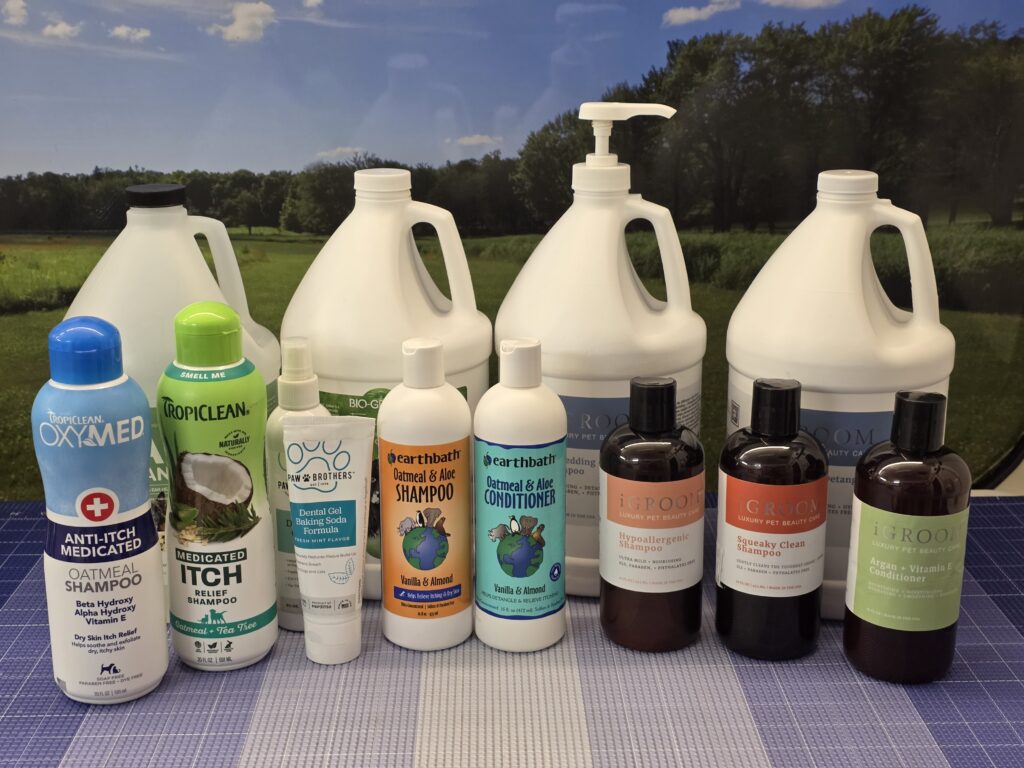
Many professional shampoos are sold as concentrates and diluted before use. Depending on the container size and dilution ratio, a concentrate can reduce packaging per gallon of working solution and reduce the amount of water shipped compared with an equivalent ready-to-use product.
A dilution ratio is measurable: it is printed on the label and you can calculate how much working solution the concentrate produces. That is more specific than a broad marketing term such as “sustainable.”
Follow the manufacturer’s ratio. Overusing concentrate wastes product, makes rinsing harder, and leaves residue in the coat — which means your dog ends up worse off and you have used more shampoo to get there.
Read what the claim actually covers
Phrases like biodegradable ingredients, plant-derived surfactants, or certified organic ingredients can be useful — when the manufacturer states plainly what the claim applies to. What I will not do is stretch them. If a company says a formula contains biodegradable ingredients, that is a statement about ingredients. It is not proof that the finished product has no environmental effect, and those two things get blurred constantly.
Certifications are worth more than adjectives, but only within their scope. A certified oil inside a shampoo is not a certified shampoo. A certification on the carton is not a certification of what is in it. Trade-association membership is not certification at all.
Refills and containers
Refill systems cut down the pumps, sprayers, and rigid bottles that accumulate over years. Reusing a durable dilution bottle makes sense too, as long as it can be cleaned properly and the manufacturer permits that use.
Reusable towels and washable grooming supplies
Durable washable towels can be reused through many grooming cycles instead of discarded after one use. The same principle applies to washable covers, reusable applicator bottles, and cleanable filters wherever hygiene requirements and manufacturer instructions permit reuse.
Buy equipment that can stay in service
Equipment lifespan matters because replacing a dryer, clipper or vacuum requires another complete product to be manufactured and transported. So the useful questions are about lifespan: are blades available, can filters be washed or replaced, are there spare parts, will the manufacturer still support it in five years?
Keeping serviceable equipment in use can avoid premature replacement and may also cost less than buying a new model.
The right tool instead of more tools
Five brushes that do not suit your dog’s coat create more waste than one brush that does. This is where coat-specific advice pays off twice — your dog gets groomed properly, and you stop buying replacements for things that were never going to work.
If you are unsure what your dog’s coat actually is, start there rather than in a shop.
Packaging and local recycling
Recycled content, recyclable materials, and reduced-plastic formats are real distinctions when they are documented. But recyclable does not mean accepted everywhere. Whether a container is recycled depends on your local facility, not on the symbol printed on the back.
Technique also reduces waste
Correct dilution, thorough rinsing, maintained tools, efficient loose-coat removal, and a regular grooming routine can all reduce unnecessary product use and equipment wear. These are practical changes that do not require buying another product and can also make grooming more comfortable for the dog.
Green Dog Grooming Guides will flag greener attributes where they are documented. But they stay part of the comparison rather than replacing the question that comes first: does this make sense for this dog, and this coat, and this grooming job?
Browse Green Dog Grooming Guides, or go straight to Grooming Products & Equipment for the practical comparisons.