
By Yvette Ehler, owner and groomer at Green Dog Mobile Grooming. Grooming since 2009.
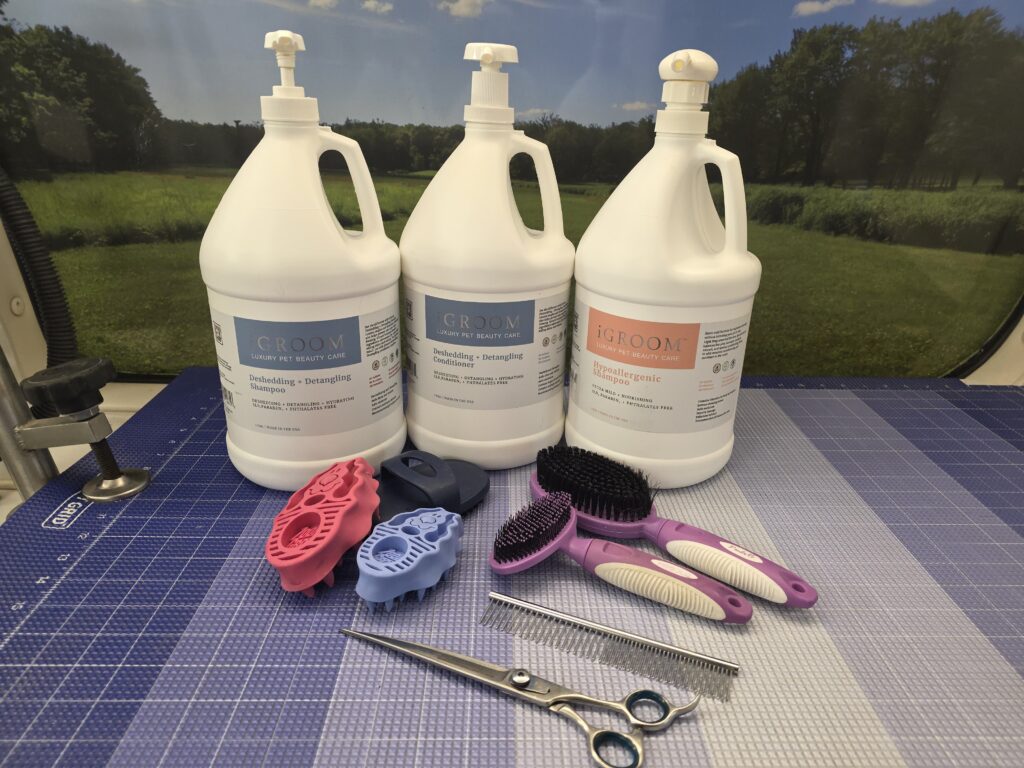
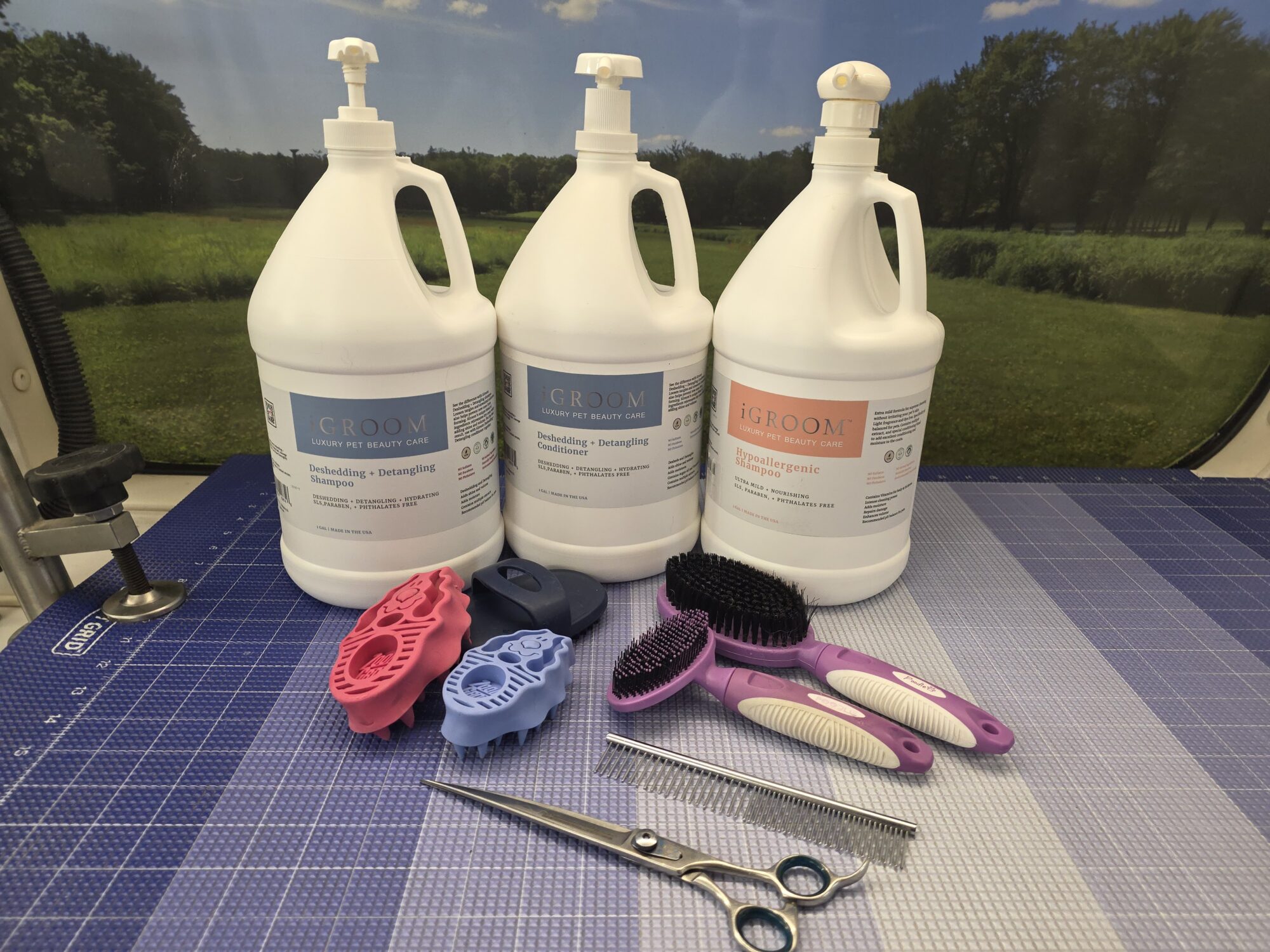
I recommend building your home grooming kit around your dog’s coat and the jobs you plan to do. A few suitable tools are more useful than a large generic set.
Start with brushing and combing between appointments. Add bathing, drying, nail care, or haircut tools for the jobs you plan to learn.
One brush, chosen for the coat
Smooth coats generally do well with rubber curry-style tools that lift loose hair without digging at the skin. Curly and drop coats usually need a slicker or pin brush plus a comb that reaches through the maintained coat length. Double coats need tools with enough working depth and tooth spacing to separate loose undercoat without cutting healthy guard hairs.
The right brush is the one that works through your dog’s coat without scraping or breaking hair. That is the practical test; packaging cannot establish whether the tool suits the coat.
A comb, to check your work
On long or curly coats maintained at enough length to tangle, a comb is not a duplicate of the brush. It is the instrument that tells you whether the brush actually reached the skin. If it catches, the section needs more work even when the surface looks smooth.
The comb is especially important on curly and drop coats because surface brushing can leave tangles closer to the skin. A full-depth comb check shows whether the section has actually been worked through.
Shampoo chosen for the job, not the label
Ask what the shampoo is meant to accomplish and whether that suits your dog’s coat and skin. Professional concentrates go a long way, because a small amount makes a lot of working solution — follow the manufacturer’s dilution rather than guessing at it.
Conditioner is useful when the coat needs more slip, manageability, static control, or separation. I use it for what it does to the coat, not simply for fragrance.
A dryer may matter more than another brush
If your dog has a dense double coat, a high-velocity dryer may improve the routine more than adding another brush. High-velocity airflow expels water, separates guard hairs and helps release loose undercoat. On curly and other coats maintained by clipping or scissoring, complete drying and coat preparation are important for an even finish.
If you are going to spend money on one significant piece of equipment, and your dog sheds heavily, this is usually where it should go.
Clippers when the coat needs regular trimming
Clippers are for continuously growing coats you intend to maintain at home. If that is your dog, choose blades and guard combs suited to that work, and look hard at blade availability, maintenance, serviceability, and spare parts.
A serviceable clipper with replaceable parts can stay in use for many years instead of being discarded when one component wears out. That can reduce both replacement cost and waste.
Nail tools
Clippers and grinders do the same job differently. Some people prefer the speed of clippers, others prefer taking small amounts off with a grinder. Visibility, controlled handling, and trimming gradually matter far more than the brand.
Towels and washable supplies
Use absorbent reusable towels, washable loops or covers where appropriate, and containers that can be cleaned and reused. Durable supplies that stay in service for years generally create less replacement waste than products that need frequent replacement.
How I compare equipment
Suitability and performance for the dog and coat come first. Then replaceable parts, repair support, warranty, washable filters, reusable components, concentration, refill availability, and recycled or recyclable packaging. Those are useful when they are specific and documented. Vague green marketing is not a specification.
Build the kit around your dog
A smooth-coated Boxer, a heavily shedding Husky, and a Poodle kept in a longer trim should not own the same grooming kit. Start with Dog Coat Types & Coat Care, work out what your dog’s coat actually needs, and buy tools only once you know the job they are being asked to do.