By Yvette Ehler, owner and groomer at Green Dog Mobile Grooming. Grooming since 2009.
When I compare dog shampoos, I look at the dilution ratio, ingredients, directions, and specific claims. The wording on the front of the bottle tells me much less.
Start with what your dog’s coat needs. Shampoo lifts oil, dust, and dirt so they can rinse away. Other ingredients may add conditioning or fragrance. You do not need a shelf full of products to do that job well.
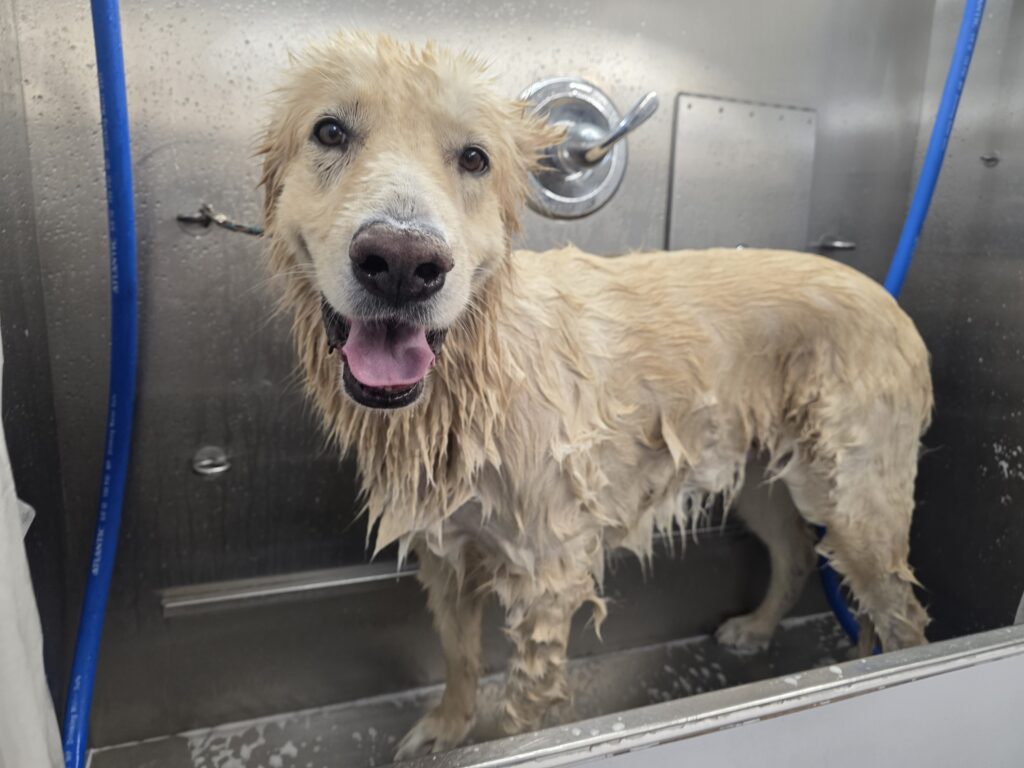
What the coat needs decides the product
A smooth coat is generally quick to saturate and rinse because there is less coat depth for water and cleanser to penetrate. A dense double coat is the opposite: water and product have to travel a long way to reach skin, and anything that does not rinse cleanly back out will sit there. On curly and drop coats, how the product affects combability after rinsing can matter as much as cleansing performance.
That means the same shampoo can be right for one dog and wrong for the next, which is why breed-labeled products are a weak signal. The coat types guide is a better starting point than the picture on the bottle.
Frequency comes into it too. A dog washed every few weeks needs something that cleans thoroughly without stripping the coat to the point where it feels harsh, and a dog washed rarely may need a more thorough cleanse when the bath does happen. Neither of those is a reason to buy the strongest product on the shelf as a default.
Concentrate or ready to use
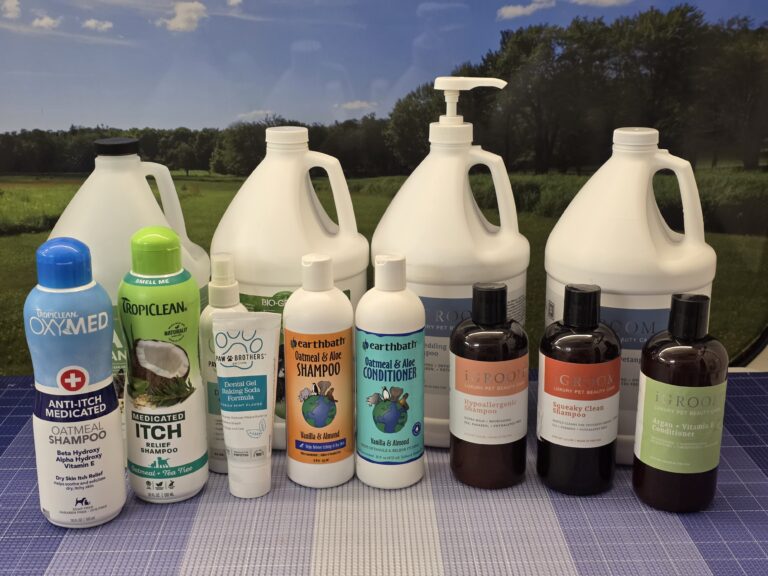
This is the first practical fork and the one most likely to change what you spend. Professional shampoo is usually concentrated and needs mixing; retail shampoo is usually pre-diluted and goes on as it comes. A concentrate at 32:1 makes about four gallons of working solution from a sixteen ounce bottle, so comparing sticker prices without doing that arithmetic tells you nothing useful.
A published dilution ratio gives you a specific mixing instruction instead of leaving the concentration to guesswork. The dilution guide covers how to read and mix these properly.
Refill formats belong in the same decision. Buying a large container that decants into a working bottle means less packaging arriving for the same amount of washing, which is a straightforward practical point rather than a marketing one, and it usually costs less per wash as well.
Reading the ingredient list within its limits
Read the manufacturer’s ingredient list as one piece of information rather than a complete formula analysis. It may identify cleansing agents, conditioners, preservatives, fragrance and color, but the list alone does not establish concentration, performance or suitability for your dog’s coat.
Some owners avoid particular ingredient classes, and manufacturers respond to that with sulfate-free, paraben-free and similar wording. Those are accurate descriptions of what is absent, and they are worth knowing if you have a reason to care. What they are not is evidence of overall quality, gentleness or environmental performance, and a product is not automatically better because something has been left out of it.
If your dog has a skin problem, this is where I stop being the right source. Persistent itching, redness, sores, hair loss or a smell that keeps coming back are questions for a veterinarian rather than for a shampoo aisle, and a medicated product used without knowing what you are treating can waste weeks. I can tell you how a shampoo behaves on a coat; I cannot tell you what is happening to the skin underneath it.
Environmental wording and what it is worth
Green language on pet products runs from precise to meaningless, and the difference is usually whether anybody could check it. A named certification has a defined scope and an organization responsible for the standard. USDA Organic addresses organic production, while Leaping Bunny addresses animal-testing practices; the names matter because the scopes are not interchangeable. Words such as natural, green, eco-friendly and non-toxic are not meaningful proof on their own without a specific standard, definition or supporting evidence.
When a manufacturer states that a formula uses biodegradable or plant-derived ingredients, that is their claim about their product, and I report it as theirs rather than converting it into a conclusion of my own. Those claims are also frequently scoped to a single formula rather than a whole range, so a clarifying shampoo described one way tells you nothing about the conditioner sold alongside it. Reading which product the claim actually attaches to is worth the thirty seconds.
The two things in this category that hold up under scrutiny are the dilution ratio, because it is arithmetic, and the packaging format, because you can see it. A concentrate produces more working solution per bottle, and a refill means fewer containers. Beyond that, I would rather tell you the evidence is thin than assemble an environmental argument out of adjectives.
What to look for on the shelf
Rinseability matters, but it is difficult to predict from the front label alone. A published dilution ratio tells you how the manufacturer intends a concentrate to be prepared; it does not, by itself, prove how easily the formulation will rinse. In use, the relevant question is whether the cleanser can be distributed through the coat and then removed thoroughly without leaving the hair feeling coated or tacky.
Fragrance strength deserves a thought of its own. A shampoo that smells overwhelming in the bottle will smell overwhelming on the dog for days, and the dog has no say in it. Lighter fragrance or none at all is a reasonable preference rather than a compromise.
Then look at specificity. A manufacturer who publishes a full ingredient list, a dilution ratio, and clearly scoped claims about which formula does what is telling you they expect to be checked. That is a better signal than any single word on the front of the bottle.
How many products you actually need
Many home grooming routines need only one suitable general cleanser and one conditioner. A second, more thorough clarifying shampoo is useful if your dog gets dirty or has a coat that builds up product, and a coat-specific formula can be useful when the coat has a specific need. Beyond that, a shelf of half-used bottles is a common outcome and not a useful one.
Buying fewer products in larger or refillable formats and using them at the correct dilution is the version of this that costs less and produces less packaging, without requiring anyone to make claims they cannot support.
The bathing guide covers the wash and rinse sequence itself, and the conditioner and detangler guide deals with the product that does most of the work on tangle-prone coats. If your dog has a dense double coat, the double coat guide explains why the rinse matters more there than anywhere else.