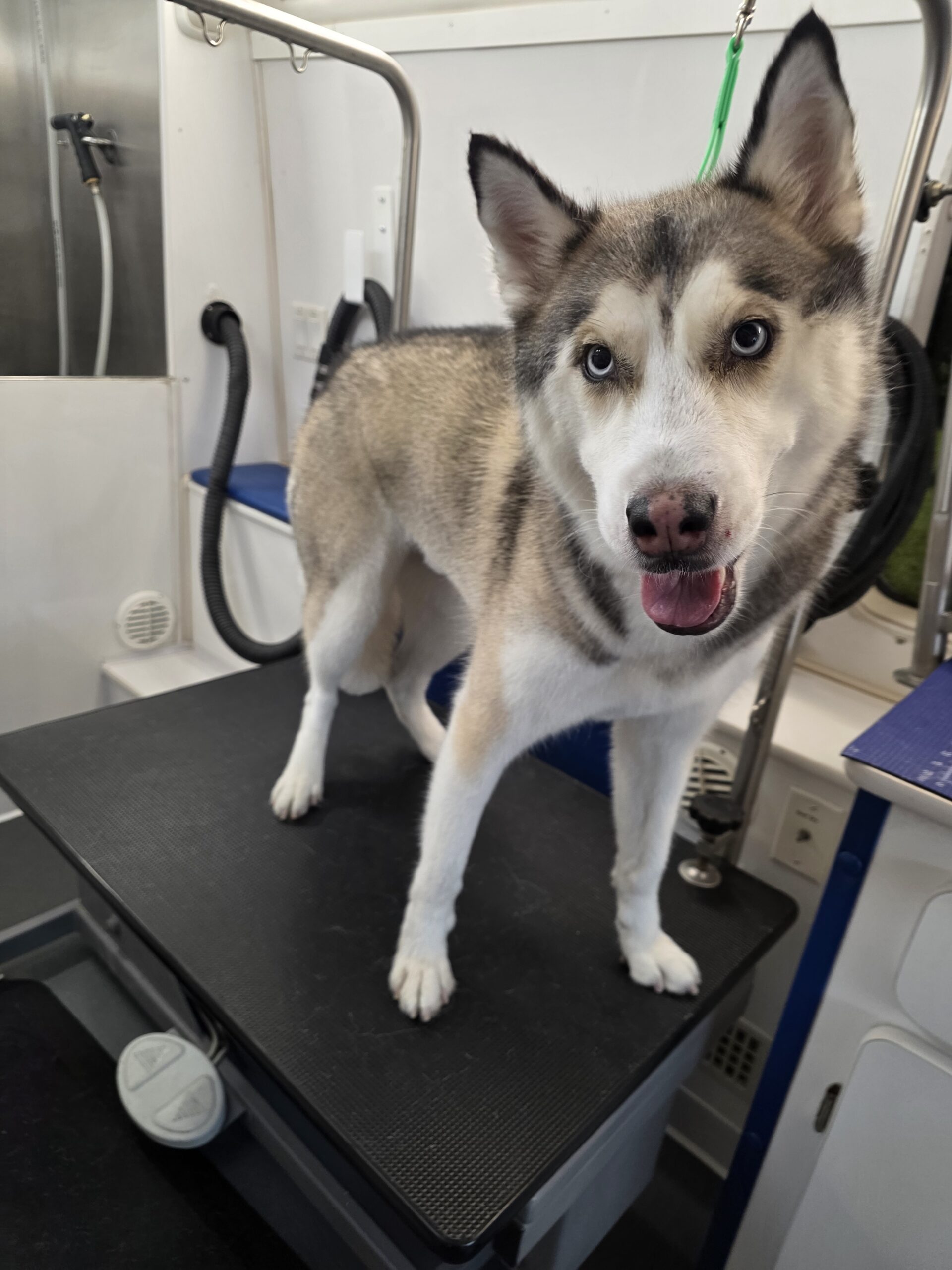
By Yvette Ehler, owner and groomer at Green Dog Mobile Grooming. Grooming since 2009.
A thick double coat can hold a lot of loose undercoat, even if you brush every day. I use the bath and dryer to release that hair before the final brush-out.
The outer coat has longer, coarser guard hairs, with softer undercoat beneath. The job is to remove loose undercoat while leaving the healthy outer coat intact.
Why the bath comes before the brushing
A dense double coat needs to be saturated through the guard coat and undercoat before shampoo is applied. If only the surface is wet, shampoo may not distribute evenly through the coat or reach the skin. On a very thick coat, thorough saturation can take several minutes.
Dense double coats need especially thorough rinsing. Product can remain near the skin under a dense undercoat if rinsing is incomplete. Rinse through the full coat depth, paying particular attention to the belly, chest and behind the front legs, where product can be easier to miss.
Conditioner on a shedding coat is doing something specific. It reduces friction between the fibers so the loose undercoat can slide free rather than clinging to the guard hairs around it, which may help more loose undercoat release during drying. The bathing guide covers dilution and rinsing in more detail.
High-velocity drying is part of deshedding
This step may be unfamiliar to owners and is one reason a professional deshed can remove more loose coat than dry brushing alone. High-velocity air separates the guard hairs, drives water out from the skin outward, and physically blows the loosened undercoat out of the coat. On a dense coat, a substantial amount may come out at this stage before the final brushing begins.
Work the airflow in sections and follow the direction the coat grows, keeping the nozzle moving rather than holding it in one place. The coat should be visibly separating down to the skin as you go, and if it is only ruffling on the surface you are too far away or the coat is still too wet in that spot. Dry all the way through rather than stopping when the outside feels dry, because a double coat that remains damp underneath may be more prone to tangling and odor.
Ear protection matters, and so does introducing the noise gradually with a dog who has not met a dryer before. Start with the airflow away from the dog, let them investigate it, and build up. With a worried dog, I introduce the dryer gradually rather than forcing a full drying session.
Rakes, undercoat tools and carding
Once the coat is clean and fully dry, the mechanical work is straightforward. An undercoat rake with teeth long enough to reach through to the skin lifts the remaining loose undercoat, and it should move through the coat with light pressure rather than being dragged. If you find yourself pulling, the coat is either not dry or the tooth spacing is wrong for that density.
Carding is the finishing version of the same idea, using a fine-toothed tool to pull remaining loose undercoat from close to the skin and leave the guard coat lying flat. It is mostly something that happens during an appointment rather than something you need to perform at home, but it can help produce a smoother finish and remove loose fiber left after raking.
Whatever the tool, it works through the coat rather than into the skin. Use light pressure and stop if the tool is scraping the skin or requires substantial force to move through the coat.
What to look for in an undercoat tool
Tooth length is the first specification, and it has to suit the depth of coat you are working through. A rake with teeth that are too short for a Malamute’s coat may work only through the surface layer. Tooth spacing is the second, with wider spacing suiting coarse dense coats and narrower spacing suiting finer ones, because spacing that is too narrow for the density simply jams.
Avoid tools with a blade edge that cuts coat rather than lifting it. They produce impressive amounts of hair quickly, and a portion of what they remove is guard coat that you wanted to keep, which changes the texture of the coat over time. I use a rake to lift loose undercoat and avoid cutting-style tools when I want to preserve the guard coat.
On construction, look for teeth firmly set rather than glued into a soft head, a handle that stays comfortable through the twenty or thirty minutes this work actually takes, and a manufacturer who sells replacement heads if the design uses them. I also look for durable construction and replacement parts, because those can keep a useful grooming tool in service longer.
What to look for in a dryer
Airflow performs the primary mechanical work. A high-velocity dryer is a motor moving a large volume of air, and many are unheated by design or produce only the modest warmth the motor generates. Force is what separates coat and lifts undercoat, so the specification worth comparing is air volume and how the nozzle concentrates it rather than any temperature figure.
Variable speed matters more than maximum power. Full force may suit a body coat on a large dense dog but is too strong for a face, ears or a nervous small dog, so a dryer with only one setting limits where you can use it. Hose length and weight affect handling and how practical the dryer is to use regularly.
Filters are the practical durability question. A washable, reusable filter that you can actually get to keeps the motor working properly and avoids a stream of disposable replacements, and available spare parts mean a dryer with a failed component gets repaired rather than replaced. Because a high-velocity dryer is a substantial equipment purchase, parts availability and serviceability are important alongside airflow and handling.
Why I don’t shave a double coat
I generally do not shave a healthy double coat for routine grooming, so I explain the coat-related reasons when an owner requests it. When a double coat is clipped short, the undercoat and the guard coat do not necessarily grow back at the same rate or in the same proportion, and the texture that returns can be different from what was there before. That change is not reliably predictable for an individual dog, which is the problem: it is a decision you cannot undo if it goes badly.
What is more certain is that shaving does not solve shedding. The undercoat is still there and still releasing, and now it is releasing in short pieces that work into fabric more stubbornly than long ones. Bathing, high-velocity drying and deshedding remove retained loose undercoat without removing the protective length of the guard coat.
Questions about thermoregulation and medical reasons for clipping belong with a veterinarian. From a grooming standpoint, my concern is preserving the normal guard coat and avoiding an unnecessary change in coat texture or regrowth. There are genuine medical and welfare reasons a double coat sometimes has to come off, and when a veterinarian asks for it, that is a different conversation.
Blowing coat and what a realistic schedule looks like
Many double-coated dogs have periods of heavier seasonal shedding, releasing substantial undercoat over several weeks. Keeping up by brushing alone can be difficult, and it is the point at which a bath and a proper dry is worth far more than any amount of daily effort. Some dogs, particularly those living with year-round climate control, shed at a steadier rate across the whole year rather than in two clear seasons.
Outside those periods, a weekly rake through with a comb check afterward keeps the coat in reasonable order, and a full bath and blow-out every four to eight weeks does the heavy lifting. In dry, dusty conditions the coat picks up grit that increases friction, so the bathing interval matters more than it would in a milder climate.
The brushing and deshedding guide covers technique across coat types, and the coat types guide explains the double-coat division and how coat length, density, guard-hair texture and undercoat volume change the grooming approach within it. If you are setting up to do this at home, the home grooming setup guide deals with the part nobody warns you about, which is where all that undercoat ends up. For a breed-specific version of everything above, the Golden Retriever guide also covers feathering care and what to tidy on a coat that is otherwise left alone.