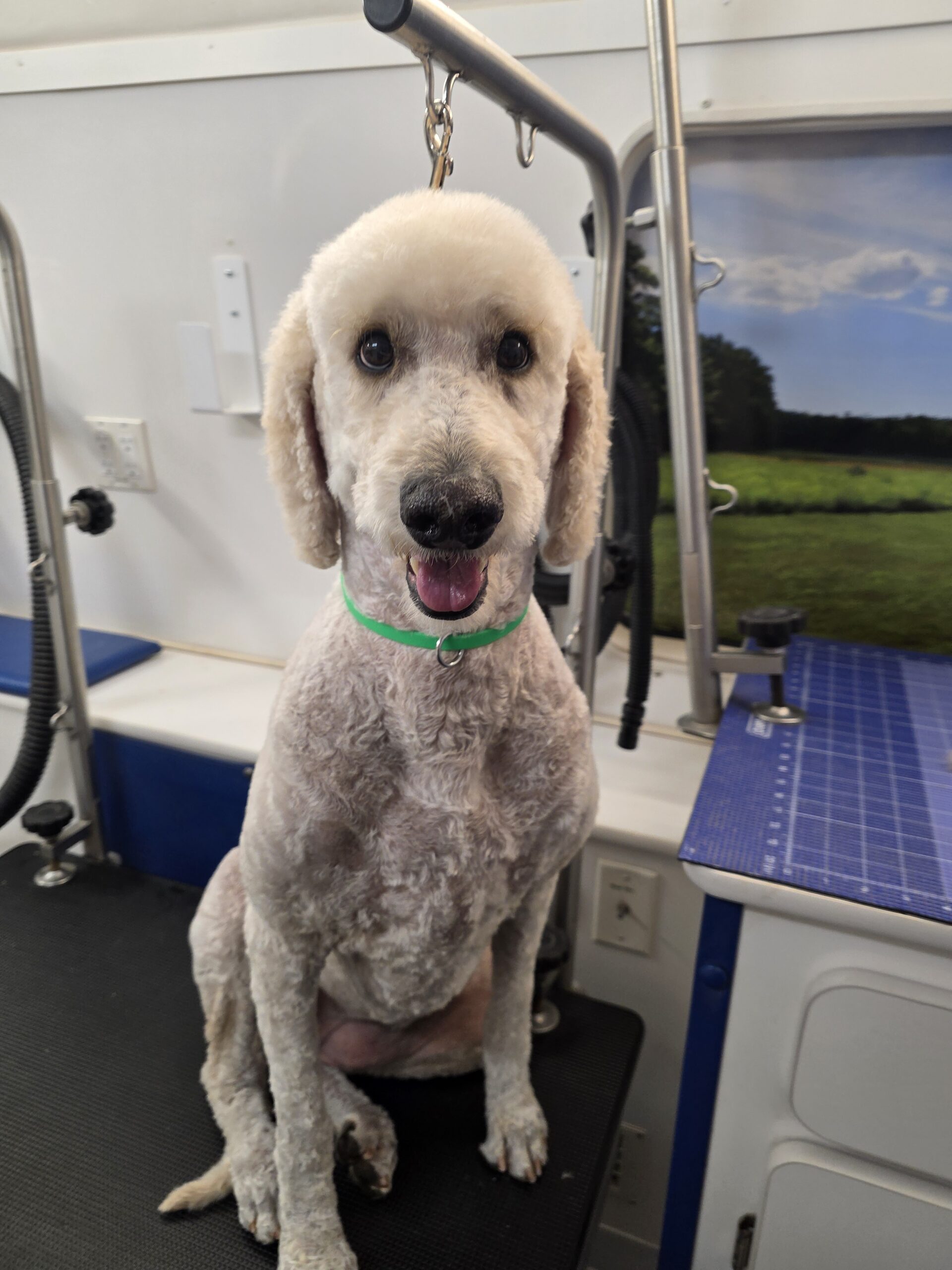
By Yvette Ehler, owner and groomer at Green Dog Mobile Grooming. Grooming since 2009.
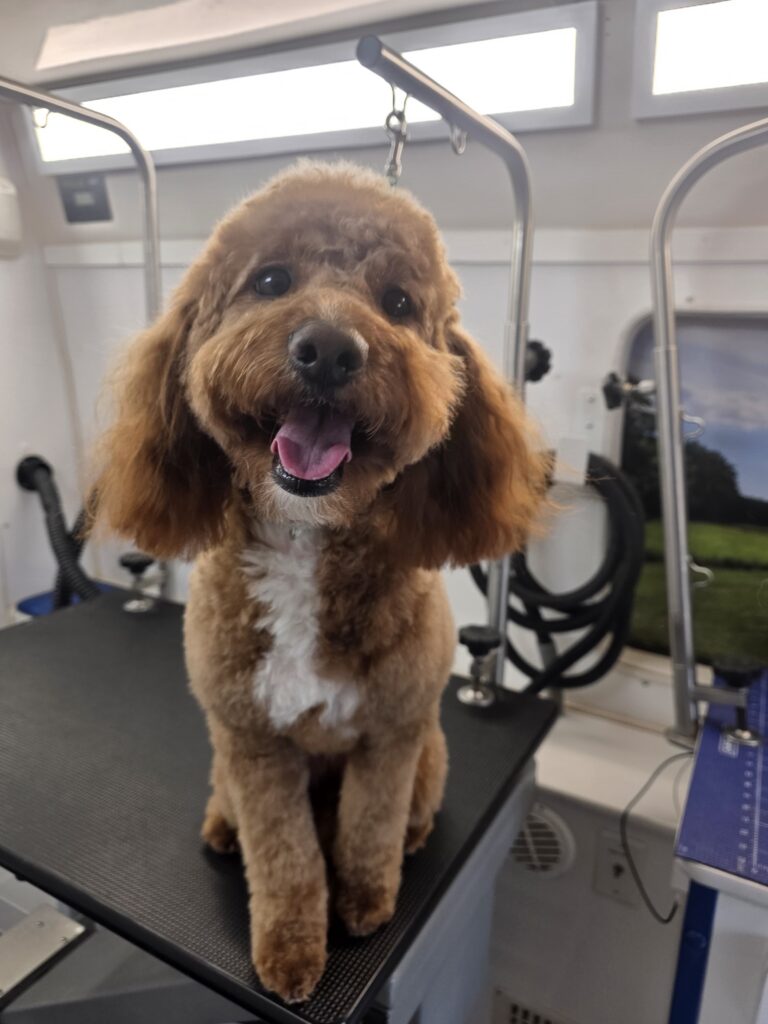
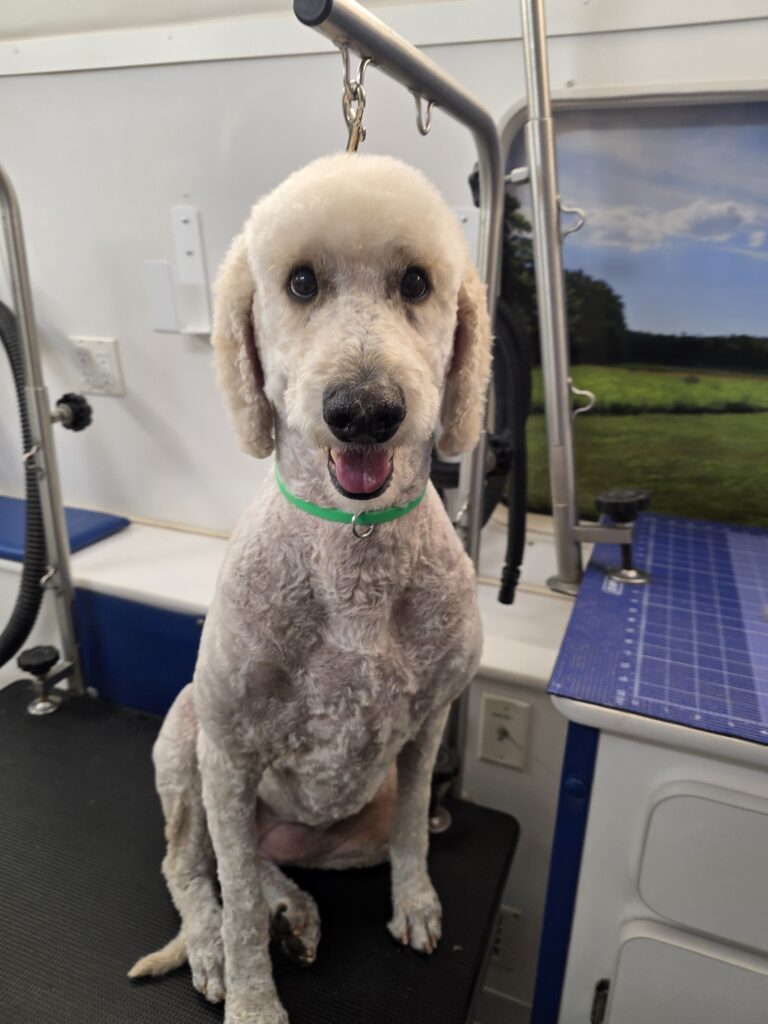
Curly coats, including Poodle and Bichon coats, keep growing and can trap loose hair in the curls. They need regular brushing, combing, and haircuts to keep that hair from turning into mats.
The surface can look brushed while tangles form underneath. I use a comb to check all the way through, close to the skin.
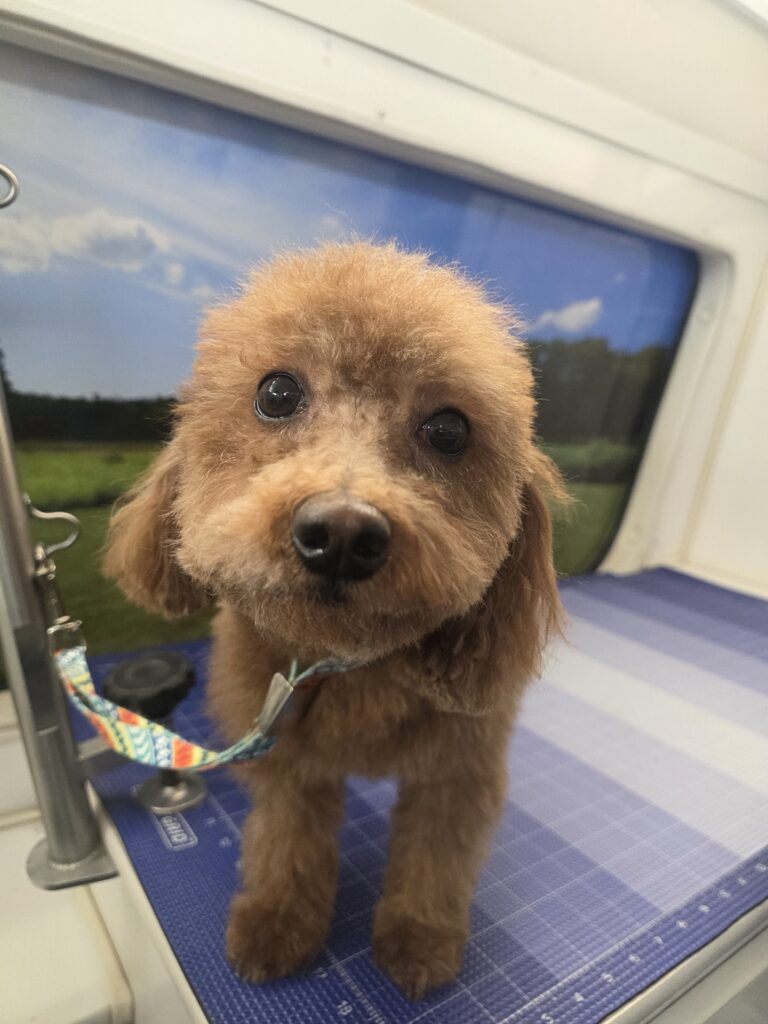
How to line brush a curly coat
Line brushing lets the brush work through the full maintained coat depth rather than only across the surface. Part the coat with one hand so you can see skin along a horizontal line, brush the band of hair below that parting outward from the skin, then release the next inch of coat down over it and repeat. You work up the leg or up the body in bands, and no band is left until it is finished.
The direction matters. Brushing from the skin outward means the pins pass through the full length of the hair, whereas brushing inward from the tips only ever grooms the outer portion, which is a common weakness in home brushing routines. Hold the coat you are not working on out of the way, keep the pressure light, and let the pins do the work rather than pressing them against skin.
Line brushing a full-coated Standard Poodle can take considerable time. For home maintenance, dividing the coat into shorter sessions—for example, legs in one session and body in another—can make thorough brushing more manageable for both the dog and the person grooming.
Use a comb to verify the brushing
After a section is line brushed, take a metal comb and run it from the skin outward through that section. If the comb passes cleanly along the full tooth length without catching, the section is finished. If it stops or has to be forced, there is matting there regardless of how the coat looks and feels, and the slicker has been traveling over the top of it.
This habit can reveal where the routine is falling short while there is still time to correct it, which is usually behind the ears, in the armpits, at the base of the tail and wherever a harness sits. Those spots need regular checking, while the open areas across the back often require less attention.
How to choose a slicker brush for a curly coat
Pin length has to match the coat length you are maintaining. A slicker with pins that stop halfway through the coat physically cannot reach the skin, so it will groom the outer half beautifully and leave the mats forming underneath, which is a common tool mismatch on this coat type. If you keep the coat long, you need longer pins than a short pet trim requires.
Firmness should be enough that the pins work through resistance without being so stiff that they scrape. A slicker that is too soft may flex away from a dense curly coat before the pins work through the maintained coat depth. Head size is about control, so a smaller head suits legs and faces and a larger one covers a body coat faster, and many people end up owning both.
On build quality, look for a pad that is properly bonded to the head, pins set firmly rather than pressed into soft backing, and a handle that stays comfortable over a long session. I prefer tools that hold up through regular use. Published material information and available replacement parts are useful details when comparing durability and waste, rather than relying on a general environmental claim on the packaging.
Choosing a comb
A metal comb with coarse teeth at one end and fine teeth at the other is useful for most of this coat work. The teeth need to be long enough to reach through the maintained coat to the skin, and the tips should be smooth and rounded so they pass through the hair without scratching.
Smooth, solid stainless construction is the main consideration. A well-made comb can remain useful for many years, which makes the comparison against a cheap comb you replace repeatedly fairly straightforward.
Bathing and conditioning for combability
Check the coat for matting before bathing. Wetting an already matted coat can make the tangles more difficult to separate as they dry, so significant matting should be addressed before the normal bath-and-dry process.
Rinse thoroughly through the full coat depth. Dense curly coats can retain shampoo or conditioner near the skin, and incomplete rinsing can leave residue in the coat. Continue rinsing until the product is fully removed and the coat no longer feels coated.
Conditioner can lower friction between hairs, which helps a comb pass through the coat and can reduce re-tangling. When I compare products for curly coats I start with rinseability, then look at the stated dilution ratio, since a concentrate produces a given volume of working solution from less product and a published ratio lets you check that arithmetic rather than take it on faith. Where two suitable products perform alike, documented ingredient information, refill availability and package format are a fair way to choose. Environmental and formulation wording on a bottle is the manufacturer’s claim, and I report it as theirs rather than as a finding.
Drying affects how evenly the coat can be clipped
Air drying preserves more of a curly coat’s natural curl. Controlled airflow and brushing straighten and separate the hair as it dries, making it easier to comb and clip evenly.
Work in sections with the airflow and the brush together, straightening the coat as it dries rather than after. The drying guide covers the technique across coat types, and it applies here with more force than anywhere else.
How preparation affects the haircut
Clippers and guard combs travel evenly through a clean, dry, fully combed coat. They do not travel evenly through hidden tangles, which is the mechanical reason a groomer sometimes cannot give you the length you asked for. When the clipper reaches a mat, a shorter blade may be required to pass safely beneath it.
Length is described by blade number and guard comb, and it helps to know roughly what each leaves. A #10 leaves about a sixteenth of an inch, a #7F about an eighth, a #5F about a quarter and a #4F about three eighths, while guard combs fitted over a shorter blade give you longer lengths from half an inch upward. With significant matting, a shorter blade may be necessary in affected areas because a longer guard comb cannot pass safely and evenly through the coat.
If you want a longer haircut, the coat has to stay brushed and combed between appointments. The length I can leave depends on whether a guard comb or blade can pass safely and evenly through the prepared coat.
A realistic schedule
Many curly coats kept at a moderate pet length benefit from line brushing with a comb check several times a week, and more when the coat is growing out toward a longer style. Haircuts typically fall every four to eight weeks depending on the length you keep and how much home maintenance is happening. If skin under a mat looks red or sore, that belongs with a veterinarian rather than with a brush.
The coat types guide places curly coats within the broader grooming coat divisions and explains the structural characteristics that distinguish them from double, drop and other coats, and the clippers and haircuts guide goes further into blade numbers, guard combs and what different lengths actually look like. For the kit itself, the home grooming tools guide covers what you need before anything else. The same line brushing and comb check applies to the fine silky coats, so the Shih Tzu guide builds on this one for face and ear care.