By Yvette Ehler, owner and groomer at Green Dog Mobile Grooming. Grooming since 2009.
When I plan a Shih Tzu groom, I start with the coat length you can maintain between appointments. A longer coat needs more brushing and combing; a shorter haircut still needs regular care.
Loose hair can stay caught in this coat. Tangles may form close to the skin even when the surface looks smooth, so I check underneath with a comb.
How much grooming does a long Shih Tzu coat need?
A full-length Shih Tzu coat generally needs daily combing, and the dog needs to be comfortable being handled for that routine. Show coats are often kept in wraps between appearances because a floor-length coat is difficult to protect during normal dog activity.
A long coat can be beautiful, but it requires substantially more maintenance than a shorter pet trim. If daily coat care is not practical, keeping the coat shorter is usually more comfortable for the dog and easier to maintain consistently.
Where the tangles form
Behind and under the ears, the ear leather itself, under the collar or harness, in the armpits, the chest, the inside of the back legs and around the rear. On a Shih Tzu the ears are the standout problem, because the ear feathering is fine, long and in constant motion, and it felts quickly once it starts.
The face is its own area. Hair grows down over the eyes, around the muzzle and under the chin, and it collects moisture from eating, drinking and normal eye discharge. That area needs cleaning and combing more often than the body does, whatever length the rest of the dog is kept at.
Brushing and the comb check
Line brushing is the technique. Part the coat so you can see skin along a horizontal line, brush the band below the parting outward from the skin, let the next inch fall and repeat, working upward in sections. Then run a metal comb through the finished section from the skin outward, and if the comb passes cleanly the section is done.
If the comb catches, work that section again even if the surface looks smooth. A slicker can move over the top of a silky coat without reaching tangles closer to the skin. The line brushing guide covers the technique in more detail; the same section-by-section method is useful on a long Shih Tzu coat when the hair is being maintained at enough length to tangle.
A Shih Tzu kept short still needs combing two or three times a week, concentrated on the ears, face and friction points. Kept long, it needs daily attention over the whole dog.
Face and eye area care
The hair around the eyes needs keeping out of them, either trimmed short or gathered up into a topknot. Both are legitimate choices and the decision is mostly about how much daily handling you want, since a topknot needs redoing and a trimmed face needs regular tidying.
Wipe the face area regularly with plain water or a product intended for the purpose, and comb it through afterward so it dries separated rather than stuck together. Staining under the eyes is extremely common in this breed and largely cosmetic, but if you are seeing genuine redness, swelling, a change in the discharge, squinting or the dog rubbing at the face, that is a veterinary question rather than a grooming one. The eye area is not somewhere to experiment.
Trimming around the eyes is close, delicate work on a dog who moves. If you are not confident with blunt-tipped scissors on a wriggling face, this is a reasonable thing to leave to an appointment rather than learn on your own dog.
The puppy cut decision and what the lengths mean
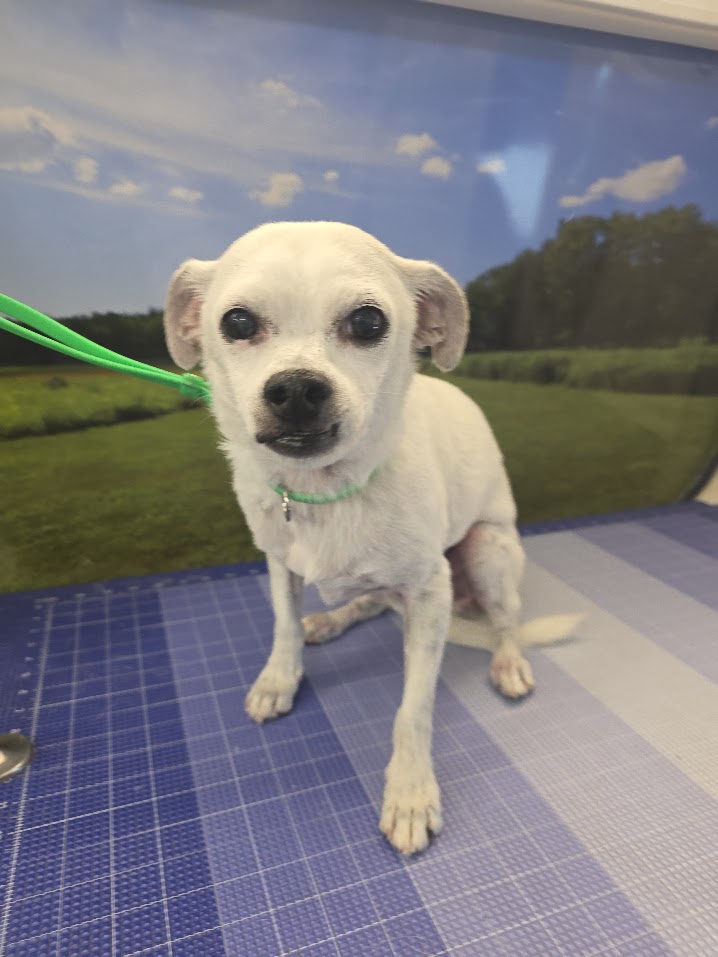
What most owners call a puppy cut is a practical all-over length, usually somewhere between half an inch and an inch, achieved with guard combs fitted over a shorter blade. It keeps the coat off the ground, dramatically reduces the daily workload, and still looks like a Shih Tzu rather than a shaved dog.
Knowing roughly what blade numbers leave makes the conversation easier. A #10 leaves about a sixteenth of an inch, a #7F about an eighth, a #5F about a quarter and a #4F about three eighths, with guard combs taking you upward from half an inch. Faces, ears and tails are usually left longer than the body whatever length the body is kept at.
A guard comb cannot travel through matting. When the coat is felted at the skin, the available length is whatever passes safely underneath, which frequently means dropping shorter than anyone wanted. The condition of the coat determines which blade or guard comb can pass through safely, so regular maintenance between appointments has a direct effect on how much length can be left.
Bathing, drying and tools
Comb the coat before bathing so existing tangles can be found and addressed before shampooing and drying add more handling and friction. Rinse thoroughly, since residue in a fine dense coat raises friction and brings tangles back within days, and use a conditioner to reduce that friction — on this coat it is doing mechanical work rather than cosmetic. Then dry the coat straight with airflow and a brush working together, because a silky coat left to air dry sets into its tangles.
For tools, a slicker with pins long enough to reach skin through your coat length, a good stainless comb with coarse and fine ends, and blunt-tipped scissors for face and feet cover almost everything. The comb is the one that matters most and the one worth buying properly, since a well-made stainless comb with smooth rounded tooth tips can remain useful for many years. Buying the correct pin length once, rather than working through two or three brushes that never reached the coat, is both cheaper and the less wasteful route.
A realistic schedule
Most pet Shih Tzus are on a four to six week haircut cycle, with combing two or three times a week in between and daily attention to the face and ears. A long coat moves that to daily combing over the whole dog. Nails, feet and sanitary areas need attention on roughly the same cycle as the haircut.
The line brushing and comb check guide is the closest technical match for maintaining this coat, and the clippers and haircuts guide covers blades, guard combs and preparation. For the products, the conditioner and detangler guide explains what actually helps a fine tangle-prone coat and what a detangling spray cannot fix.