
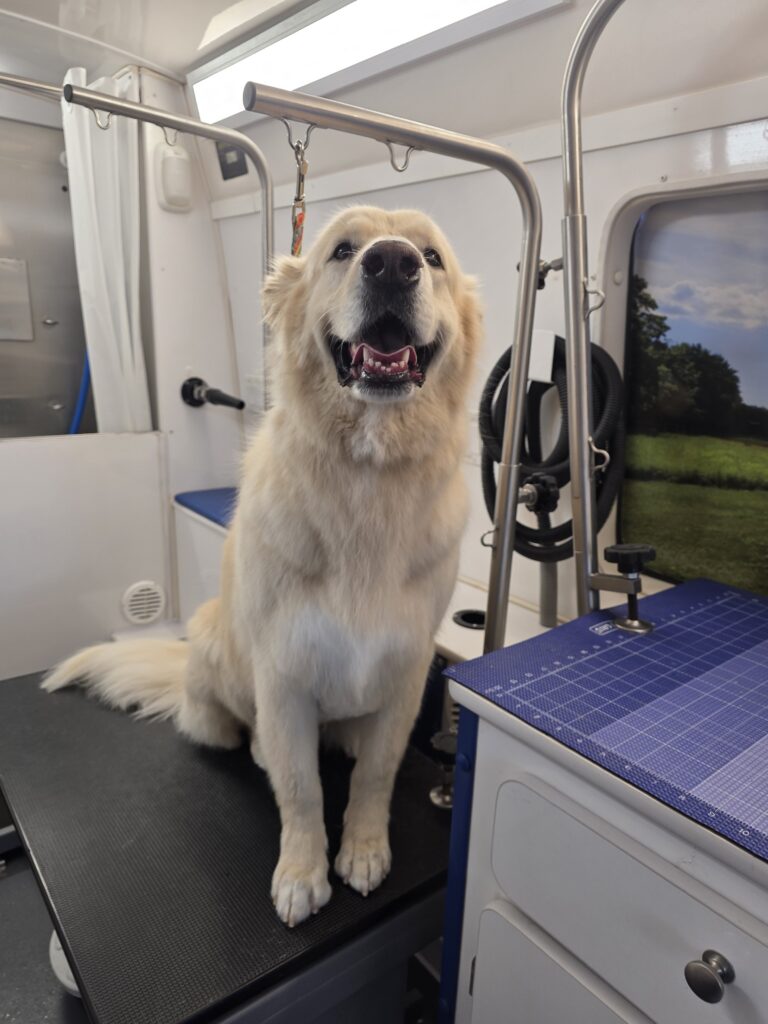
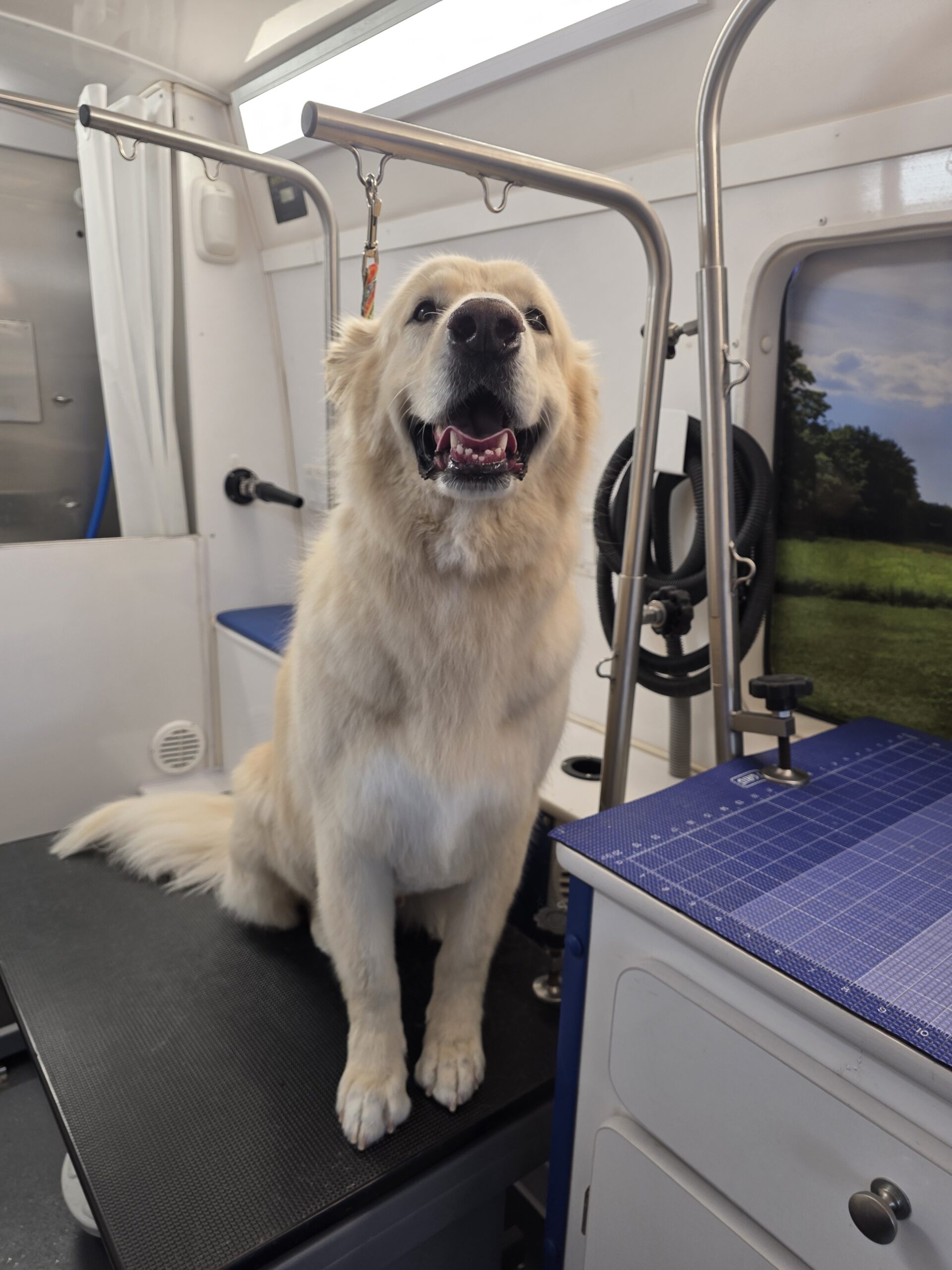
By Yvette Ehler, owner and groomer at Green Dog Mobile Grooming. Grooming since 2009.
A Golden Retriever can keep shedding even with daily brushing. Loose undercoat gets caught beneath the outer hair. I use the bath and dryer to release much of it before the final brush-out.
I check the thick body coat separately from the longer hair on the chest, legs, and tail. That longer hair can tangle, so it needs its own comb check rather than the same treatment as the body.
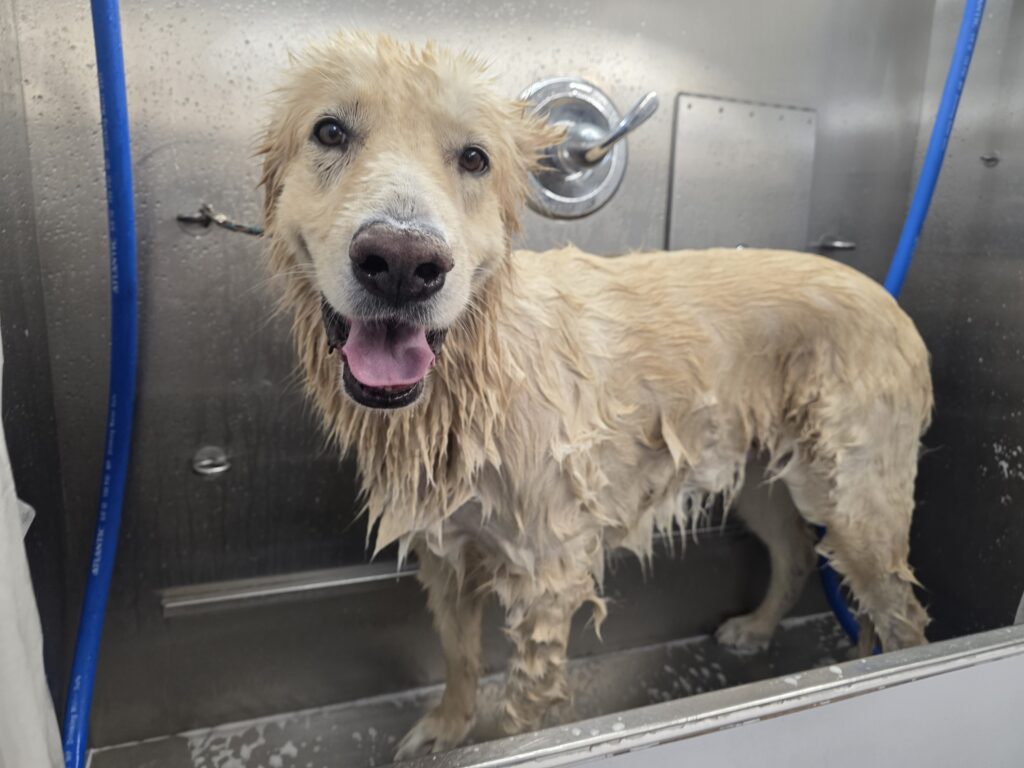
Bathing is the start of the deshedding, not a separate chore
Water and shampoo have to travel down through the guard coat to reach the skin, which takes considerably longer on a dense coat than it looks like it should. Soak the coat properly before any product goes on, because shampoo applied to a coat that is only wet on the outside sits on top and never gets to where the loose hair and debris are. On a full-coated Golden that can mean several minutes of water alone.
Thorough rinsing is especially important in a dense double coat because product can remain within the undercoat after the surface appears rinsed. Residual shampoo or conditioner can alter coat feel and increase friction between hairs. Rinse through the full coat depth, then recheck dense areas such as the chest, belly and armpits behind the front legs.
Conditioner can reduce friction between adjacent hairs and improve slip through the coat. On a dense double coat, that can make later drying and brushing easier, provided the product is appropriate for the coat and rinsed according to its directions. The bathing guide covers the sequence, and the dilution guide explains why using a concentrate at the right strength makes the rinse achievable in the first place.
High-velocity drying releases loosened undercoat
This step may be unfamiliar to owners and is one reason a professional deshed can remove more loose coat than dry brushing alone. High-velocity air separates the guard hairs, drives water outward from the skin, and physically blows the loosened undercoat out of the coat. A substantial amount of loose undercoat can be removed during this stage before the final brush-out begins.
Work in sections following the direction the coat grows, keeping the nozzle moving rather than parking it in one spot. The coat should be visibly separating down to the skin as you go; if it is only ruffling on the surface, you are too far away or that area is still too wet. Dry all the way through rather than stopping when the outside feels done, because a dense coat that remains damp underneath may be more prone to tangling and odor.
Introduce the noise gradually with a dog who has not met a dryer before. Start with the airflow pointed away, let them investigate, and build up over several sessions. Taking the introduction slowly can make future drying sessions much easier for both the dog and the person handling them.
Where do Golden Retrievers get mats?
Behind and below the ears is the classic Golden problem area, and it mats tight and fast. After that: the chest under a collar or harness, the back of the front legs, the trousers on the back legs, and the underside of the tail. These need a comb through them regularly, and the comb checks the full coat depth more reliably than a brush passing over the surface.
Ear feathering in particular is worth doing weekly whatever else you skip. It is fine, it moves constantly, and once it felts against the base of the ear it is uncomfortable to work out. A slicker followed by a comb check through that area takes two minutes and prevents most of the trouble.
What to trim and what to leave
Goldens are tidied rather than cut. The feet get neatened, the hair between the pads gets taken out so the dog has traction and does not collect debris, the hocks get tidied to a clean line, the ear feathering is neatened at the edges, and a sanitary trim keeps the rear practical. That is the typical list for many pet Goldens.
The body coat stays. A Golden is maintained through bathing, drying and undercoat removal rather than by taking the length off, and shaving one does not solve shedding — the undercoat is still there and still releasing, now in short pieces that work into fabric more stubbornly than long ones. When a double coat is clipped short, the undercoat and guard coat do not necessarily grow back at the same rate or in the same proportion, and the texture that returns can be different from what was there before. That is not reliably predictable for an individual dog, which is the reason not to gamble.
Tools worth buying once
An undercoat rake with teeth long enough to reach through to the skin does the bulk of the work after drying, and it should move with light pressure rather than being dragged. Tooth spacing matters as much as length, with wider spacing suiting a dense coarse coat. Avoid tools with a blade edge that cuts coat rather than lifting it, because a portion of what they remove is guard coat you wanted to keep.
A slicker for the feathering and a metal comb for checking cover the rest. A well-made stainless comb with smooth, rounded tooth tips can remain in use for many years. Replacement heads or parts can also extend the useful life of an undercoat rake instead of requiring the whole tool to be replaced when one component wears out. Choosing a tool that suits the coat from the beginning can reduce both cost and waste.
A realistic schedule
Many Goldens have periods of heavier seasonal shedding, releasing substantial undercoat over several weeks, and keeping up by brushing alone can be difficult. That is exactly when a bath and a full blow-out earns its keep. Some dogs living with year-round climate control shed at a steadier rate across the whole year rather than in two clear seasons.
Outside those periods, a comb through the feathering weekly and a rake through the body coat weekly keeps things in order, with a full bath and dry every four to eight weeks doing the heavy lifting. In dry, dusty conditions the coat picks up grit that increases friction, so bathing matters more there than it would in a milder climate.
The dense double coat guide goes further into the deshedding sequence and what to look for in a rake and a dryer. The brushing and deshedding guide covers technique across coat types, and the drying guide deals with the step that does most of the work on this coat.